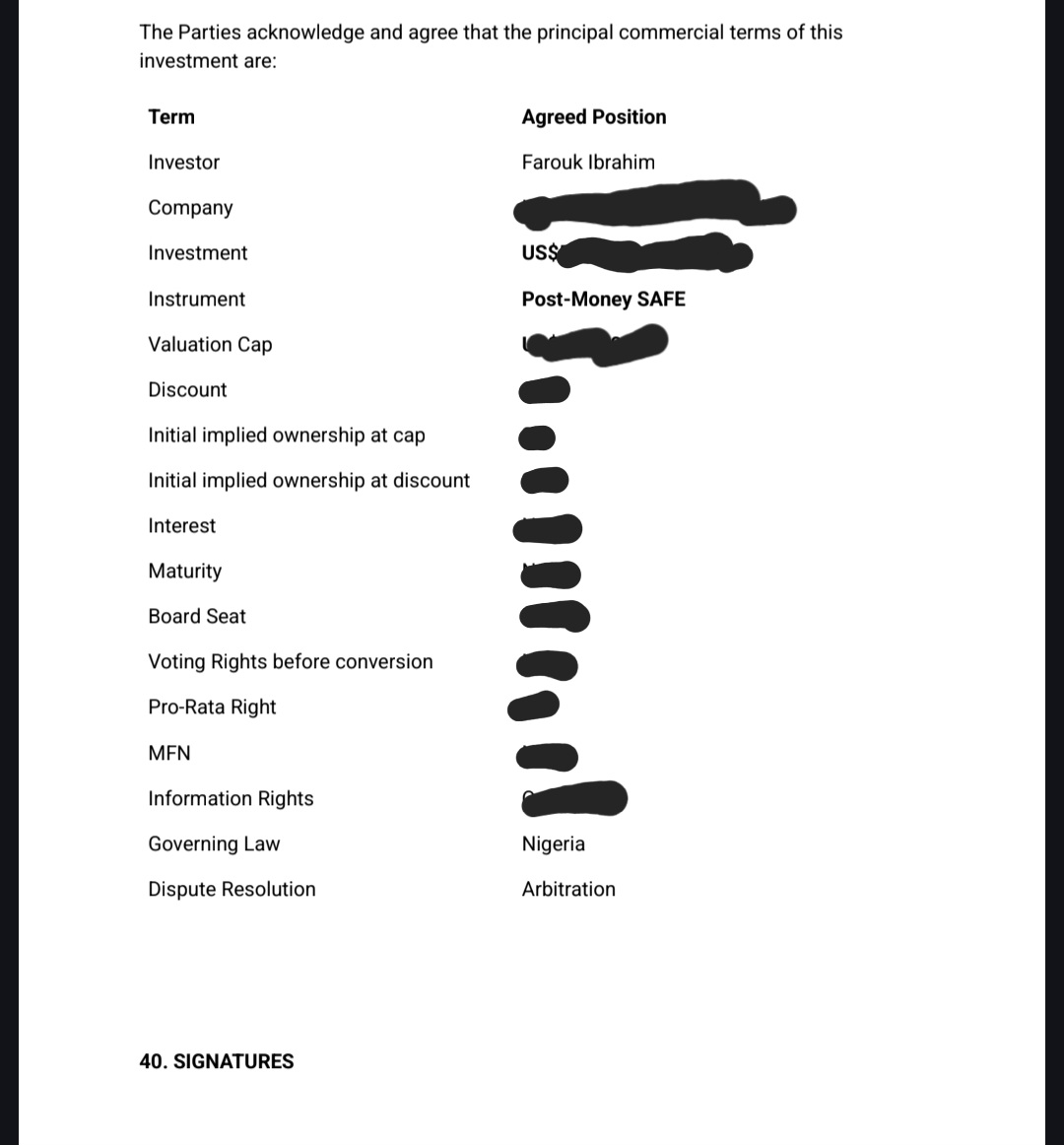
I became an Angel Investor.
My most productive conversations are usually the ones where we go deep into ideas about how to solve a problem I am ridiculously excited about.
Especially when I am having those conversations with people who are, in some ways, orders of magnitude smarter than me.
As much as I love getting my hands dirty and building things myself, I unfortunately cannot build everything I am excited about.
So you can imagine the awe I feel when I meet someone who has made it their life's purpose to solve a problem I have merely been dreaming about.
And I think Nigeria is full of these kinds of problems.
There are so many opportunities here, but taking advantage of them often requires thinking differently about how you approach the problem.
Sometimes, the obvious way simply doesn't work.
Sometimes, the idea sounds completely crazy until you understand the problem deeply enough.
And sometimes, you need to do things that would probably never make sense in another market.
I have met founders with ideas that, at first glance, make you wonder why anyone would even attempt them given where we are.
But then you spend an hour talking to them and suddenly the idea doesn't seem crazy anymore.
It seems inevitable.
For instance, I met a founder who had realized that getting his startup's product to mass adoption would require going into politics.
Now, I found this both wild and extremely interesting.
Not because I particularly wanted to see a startup founder become a politician, but because he had identified something fundamental about the environment he was operating in and was willing to do something unconventional about it.
Most people would probably look at the idea and say, that's crazy.
I looked at it and thought, this is bold.
PS: I invested in his startup.
And that, I think, is part of why I became an angel investor.
The investing landscape hasn't changed nearly as much as I think it should.
It can still be boring, intimidating for founders, and, perhaps more concerning, it puts enormous pressure on founders to grow like their Western counterparts.
I don't subscribe to that idea.
A Nigerian company doesn't necessarily need to look like an American company to be a great company.
The constraints are different.
The opportunities are different.
The way you have to navigate the market is different.
So why shouldn't the way we build companies, or even the way we finance them, be different too?
This also shapes the kinds of companies I am interested in.
I am particularly interested in businesses that can reach beyond the usual startup demographic.
A lot of startups, especially technology startups, are built for people who are already tech-savvy, internet-aware and relatively comfortable navigating digital products.
There is nothing wrong with that. But it means there is an enormous part of the country that is largely invisible to the startup ecosystem.
I am interested in businesses that connect with the below-middle-class.
Businesses that can become part of the everyday lives of ordinary people, or the everyday operations of their businesses.
Businesses that solve real pain points for a large number of people, not just a very specific class of people.
I am interested in businesses that can grow organically because people actually need them.
That distinction matters to me.
Not every startup needs to build the next billion-dollar company.
And not every startup needs to "build the future."
Some startups will simply build a very valuable company for the founders, the investors and perhaps the first few employees.
There is absolutely nothing wrong with that.
But I don't think enough of those companies, by themselves, move Nigeria in the direction I want to see it go.
I am more interested in companies that can create economic activity beyond their own cap table.
Companies that can create jobs across social classes.
Companies that can give people who have traditionally been left out of the technology economy a way to participate in it.
Companies that can become infrastructure for everyday life.
Companies that shape and leverage culture.
Because I don't think the most important companies in Nigeria will necessarily come from the categories we currently consider important.
I think some of them will come from founders who see something everyone else has become accustomed to.
Something that doesn't work.
Something that people have learned to live with.
And decide that they are going to fix it.
I think this new class of bold founders needs a new class of investors.
Investors who are willing to understand the weirdness of the problem before judging the weirdness of the solution.
Investors who are willing to make bets that don't fit neatly into an investment thesis.
And, most importantly, investors who are willing to be as bold with their capital as the founders are with their ideas.
I want to be one of those investors.
So, I became an angel investor.